How to Choose a 16x24 Heat Press
Choose a 16x24 swing away heat press when oversized transfers need a clear loading area and side access. Measure the full machine footprint, swing path, operator space and electrical setup before you buy.
On this page (10 sections)
- Why choose a 16x24 heat press?
- What does swing away mean?
- How much workspace does a 16x24 swing away press need?
- Swing away vs clamshell: which opening style fits?
- Do you need an automatic heat press machine 16x24?
- What pressure and heat controls should you compare?
- How do you place an oversized garment?
- What electrical and safety details matter?
- What should you check before buying?
- Final decision: which 16x24 heat press layout fits you?
The best 16x24 heat press for oversized transfer projects gives you a full loading area, a safe opening style and enough clearance to work around the garment. A swing away heat press 16x24 is especially useful when you want the hot platen moved aside before placing or removing material.
A large platen does not solve every workspace problem. You also need room for the upper platen to swing, space to center wide garments and a stable surface that can support repeated pressing.
This guide explains how to compare a 16x24 swing away press with clamshell and automatic designs. For a broader overview of press types, start with our heat press machine buying guide.
Why choose a 16x24 heat press?
Choose a 16x24 press when your regular projects need more width or depth than a standard 15x15 platen provides. The larger working area can make wide transfers easier to position without dividing the design into sections.
A 16x24 size can be useful for:
- Large front or back garment designs
- Wide shirt layouts
- Oversized hoodies and other broad garments
- Large fabric panels
- Bags and flat craft blanks that need more coverage
- Transfer projects where repositioning would be inconvenient
The main benefit is working area, not automatic quality. A larger platen still requires accurate alignment, suitable pressure and a pressing surface that stays flat.
A wide machine can also make small projects feel less efficient. If most of your work uses compact designs, compare the footprint, power needs and storage demands before choosing oversized equipment.
What does swing away mean?
A swing away press moves the upper platen to the side, giving you a more open loading area. This opening style keeps the hot surface away from the garment while you position the transfer, which can make wide projects easier to see and reach.
The side movement is also the main space requirement. A swing away press needs clear room beside the base, not only space in front of the machine.
Before buying, mark the base and the complete swing path on your table or workbench. Check whether the platen would hit a wall, shelf, second machine or your normal standing position.
A swing away design can suit careful placement because the garment is easier to access from above. It may be less convenient in a narrow room where the platen cannot move fully to the side.
See our best swing away heat presses for more options in this opening style. If you need a slightly smaller format, compare the best swing away heat press 16x20 models.
How much workspace does a 16x24 swing away press need?
A 16x24 swing away press needs space for four things: the base, the open platen, the garment and the person operating it. Measure the entire working envelope before comparing features.
Use this simple layout check:
- Measure the available table width and depth.
- Mark the press base in tape.
- Mark a 16x24 in working rectangle on the lower platen area.
- Mark the upper platen's swing path beside the base.
- Leave room to stand, turn a garment and reach the controls.
- Confirm that nearby shelves, walls and machines do not block the open position.
The listed cabinet dimensions on a product page may describe the machine in one position. They do not automatically show the clearance needed when the upper platen is swung aside.
Also consider the table itself. It should remain stable when you apply pressure and when a wide garment hangs over the edge.
A crowded table can cause wrinkles, crooked transfers or awkward handling.
Keep the electrical connection reachable without placing the cord across the loading area. A clean work path matters more with a large press because wide garments already need careful handling.
Swing away vs clamshell: which opening style fits?
A swing away press is usually the better match when you want side access around a large garment. A clamshell can be better when the room is narrow and you prefer a top-down opening that stays within a smaller front-to-back area.
Compare the layouts this way:
| Opening style | Main advantage | Main space demand | Good fit for |
|---|---|---|---|
| Swing away | Upper platen moves aside for loading | Side clearance and full swing path | Wide garments and careful placement |
| Clamshell | Top platen opens upward over the base | Vertical clearance and front loading space | Compact tables and quick top-down loading |
| Automatic drawer-style | Work surface can slide outward on some models | Front clearance for the moving board | Users who want the hot area farther from their hands |
A swing away opening can give you a clearer view of the design before pressing. It also asks you to plan the side of the machine as part of the workstation.
A clamshell keeps the machine's movement more centered, but the upper platen remains over the garment while you load it. That can affect access on thick or bulky items.
Read our comparison of the best clamshell heat presses if your table has limited side clearance.
Do you need an automatic heat press machine 16x24?
An automatic heat press machine 16x24 can help when you repeat the same type of transfer and want the press cycle to handle more of the lifting or release work. Automation is most useful when it matches your workflow, not simply because it sounds faster.
Check what “automatic” means for the specific model. It may refer to automatic pressing, automatic release, pressure adjustment or a combination of controls.
Those functions are not interchangeable.
You should also check how much room the automatic motion needs. A drawer-style design may need front clearance, while a swing away automatic press may need side clearance.
For repeated projects, consider:
- How often you press the same size
- Whether you need to adjust pressure for different materials
- Whether the press releases by itself
- Whether you can reach the controls without crossing the hot area
- Whether the automatic cycle fits your transfer instructions
- Whether the machine can be paused or adjusted when a garment needs repositioning
An automatic heat press 16x24 may reduce repeated lifting, but you still need to center the item and confirm the transfer is flat. Automatic movement does not remove the need for careful setup.
The products below are smaller 15x15 alternatives rather than 16x24 presses. For a larger automatic option, compare 16x20 automatic heat presses.
They help show the trade-off between compact equipment, automatic controls and larger-project requirements.
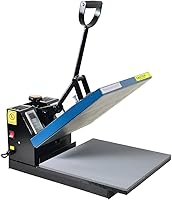
Fancierstudio Digital Heat Press 15 x
The Fancierstudio Digital Heat Press 15 x suits buyers who need a compact upward-opening press with manual pressure adjustment and electronic time and heat controls. Its 15-by-15-inch heat press sheet is smaller than a 16x24 workspace, so it fits standard-sized projects better than oversized transfers.
It uses 110 volts and 1800 watts. The temperature range is 0–699 °F, and the time range is 0–999 seconds.
A silicon-gel base board and glued-down silicon rubber base are part of its design.
The upward-opening layout can save space compared with a side-swinging platen, but you still need room to lift the top section. Its listed dimensions are 33 in L x 23 in W x 20 in H, so measure the complete cabinet area before setting it on a table.
This model can suit a buyer whose projects include T-shirts, bags or mouse pads and who wants adjustable pressure. For garment pressing steps, see how to heat press a T-shirt.
Choose a larger 16x24 press instead if wide transfers are a regular need.
HTVRONT Auto Heat Press Machine for T
The HTVRONT Auto Heat Press Machine for T suits users who want a 15x15 automatic workflow with auto release and automatic adjustment for project thickness up to 1 in. For operating steps, see the HTVRONT press setup guide.
It is not a 16x24 press, but its automatic format can suit smaller projects where reduced manual lifting matters.
HTVRONT says this model reaches 320 °F in 4 minutes and 410 °F in less time than another automatic press. It uses NTC thermistor technology and a dual-tube heating engine for heat distribution and temperature control.
The machine has 4 fast modes, 2 custom modes and an auto mode. It can press T-shirts, totes and apparel, and it can work with wood signs and ceramic coasters up to 1 in thick.
Its slide-out board separates the hands from the heating plate during loading. The unit also has a 15-minute automatic shutoff feature.
Its dimensions are 20 in L x 12 in W x 16 in H, and it uses 120 volts.
Choose it when an automatic 15x15 workflow is more useful than oversized coverage. For wide front designs or large flat panels, the 16x24 format gives you more room to position the transfer.
HTVRONT Auto Heat Press
The HTVRONT Auto Heat Press suits users who want automatic pressing with adjustable pressure and more height for thicker projects. Its 15x15 platen still falls short of a 16x24 work area, but its pressure adjustment can help when project thickness and pressure needs vary.
The press can adjust pressure up to 170 lb and supports items up to 1.77 in high. HTVRONT says it heats to 410 °F within 5 minutes and 30 seconds and uses an NTC thermistor with a dual-tube heating engine.
After you set the parameters, pressing starts with the “R” button. The machine buzzes when the timer ends and releases the material automatically.
A 15-minute automatic shutoff feature adds a safety control.
The screen angle adjusts through 7 levels from 0° to 75°. The machine uses 120 volts and 1500 watts, with alloy steel and aluminum listed as its material types.
Choose this model when automatic operation, adjustable pressure and extra height matter more than a wide platen. Choose a 16x24 machine when your main problem is transfer width rather than project thickness.
What pressure and heat controls should you compare?
Compare pressure adjustment, temperature control and time control as separate features. A useful 16x24 press lets you set the cycle for the transfer and adjust pressure for the garment or blank.
Pressure affects contact between the transfer and the pressing surface. Too little contact can create an incomplete transfer, while too much pressure can make loading difficult or affect a thick item.
Look for controls that are easy to read while the garment is positioned. Digital controls can help you set a repeatable time and temperature, but the correct values still depend on the transfer material and its instructions.
An adjustable pressure knob or mechanism can be useful when you work with different thicknesses. It does not mean every material can use the same settings.
Write down successful settings for each common project. This creates a simple reference for repeated work and reduces guesswork when you return to a design later.
How do you place an oversized garment?
Place the garment so the transfer area lies flat and the seams do not sit under the main design. For wide garments, center the design with the garment aligned to the platen before starting the cycle.
Use a firm, flat pressing surface. Smooth wrinkles away from the transfer zone, and check that folds, zippers, collars or thick seams are not pushing the design upward.
For a large front design, decide whether the garment needs to hang off the edge of the lower platen. If it does, make sure the hanging fabric does not catch on the machine or table.
A swing away platen gives you more access while loading. Take advantage of that access before the platen moves back into position.
Do not treat the 16x24 size as permission to place every garment off-center. The transfer still needs even contact across its full area.
What electrical and safety details matter?
Check the voltage and wattage before setting up the press. The machine should connect to a suitable outlet without an overloaded extension arrangement or a cord crossing the work area.
Keep the hot platen away from loose paper, fabric scraps and other heat-sensitive items. Give the machine space around its moving parts, and keep the controls visible.
The specific safety features vary. For example, the HTVRONT Auto Heat Press Machine for T has a 15-minute automatic shutoff, and the HTVRONT Auto Heat Press also has a 15-minute automatic shutoff.
Those features do not replace supervision during setup and loading.
Read the operating instructions for the exact press you choose. Follow the recommended heat, time and pressure settings for your transfer material rather than copying settings from another project.
What should you check before buying?
Check the platen size first, then confirm the opening style and full workspace. A true 16x24 press should fit the projects you make without forcing the garment into a smaller usable area.
Use this buying checklist:
- Confirm the pressing area is actually 16x24 in.
- Measure the closed machine and the fully open position.
- Mark the swing path if you choose a swing away model.
- Check table depth, width and stability.
- Leave room for the garment to hang without catching.
- Compare manual, automatic and drawer-style operation.
- Check pressure adjustment and control access.
- Confirm voltage and wattage for your workspace.
- Check the height needed for bulky items.
- Keep the manual's transfer instructions available.
- Plan where the machine will cool and be stored.
The best automatic heat press machine 16x24 is not always the best choice for a small craft room. A compact 15x15 automatic press may be easier to place, while a manual 16x24 swing away press may be better for wide designs.
Final decision: which 16x24 heat press layout fits you?
Choose a swing away heat press 16x24 when wide transfers, open loading access and side clearance are your main needs. Choose a clamshell when your table is narrow and top-down loading suits your projects.
Choose an automatic heat press 16x24 when repeated pressing and automatic release justify the added movement and workspace planning. Choose a smaller 15x15 machine when compact storage matters more than oversized coverage.
The Fancierstudio Digital Heat Press 15 x fits buyers who want a 15-by-15 upward-opening machine with adjustable pressure. The HTVRONT Auto Heat Press Machine for T fits buyers who want automatic operation and auto release.
The HTVRONT Auto Heat Press fits buyers who want automatic pressing, adjustable pressure and more pressing height.
Measure first, then choose the opening style that leaves you enough room to load the garment safely. That decision matters as much as the platen size.
Frequently asked questions
Is a 16x24 heat press better than a 15x15 model?
A 16x24 heat press gives you a larger working area for oversized transfers, wide garments and larger flat items. A 15x15 model can suit smaller shirts, bags and compact workspaces, but it does not provide the same 16x24 pressing area.
Choose based on your largest regular project.
How much room does a 16x24 swing away heat press need?
A 16x24 swing away heat press needs room for the machine footprint, the platen's side-to-side swing, loading space and operator clearance. Measure the full open position, not only the closed cabinet.
Keep the control area and electrical connection accessible after installation.
Should I choose a swing away or clamshell heat press?
Choose a swing away press when you want the upper platen to move away from the garment while loading. Choose a clamshell when a smaller opening footprint and faster top-down workflow matter more.
Your available table depth, side clearance and project thickness should guide the choice.
What should I look for in an automatic 16x24 heat press?
Look for automatic pressure or release, adjustable settings, a work area that fits your transfers and a layout that keeps controls easy to reach. Confirm the actual platen size and the machine's clearance needs.
Automatic operation can reduce repeated manual lifting, but it does not replace careful garment placement.
Can a 16x24 heat press handle small designs?
A 16x24 heat press can handle small designs, but its larger platen and cabinet may take more room than you need. A smaller press can be easier to place and move.
Choose the larger size when wide transfers, oversized garments or production flexibility justify the extra workspace.