What Is a Flatbed Scanner on a Printer?
A flatbed scanner on a printer is a glass scanning bed built into an all-in-one printer. You place an original face down on the glass so the printer can copy or digitize it.
On this page (9 sections)
- How does a flatbed scanner on a printer work?
- Which originals need flatbed scanning?
- How is a flatbed scanner different from a printer feeder?
- What should you look for in a flatbed printer scanner?
- Is a flatbed scanner good for old photos?
- Can you scan cards and other thick originals?
- What is the difference between a flatbed scanner and a printer scanner combo?
- How do you use a flatbed scanner on a printer?
- Is a flatbed scanner on a printer worth it?
A flatbed scanner on a printer is a glass scanning bed built into an all-in-one printer. You place the original face down on the glass, close the lid, and the machine captures the page or image for copying, saving, emailing, or printing.
The flatbed part is different from a sheet-fed scanner. A sheet-fed scanner pulls loose pages through rollers, while a flatbed scanner keeps the original still under a moving scan head.
How does a flatbed scanner on a printer work?
A flatbed scanner uses a glass surface, a lid, and a moving light and sensor to read an original. The scan head travels beneath the glass and turns the page or image into a digital file.
The glass gives you control over placement. You can line up a page with the edge guides, center a photo, or position a small original without feeding it through rollers.
Most printer scanner combos let you scan from the printer's control panel or from software on a connected computer. The exact buttons and file options vary by model.
Which originals need flatbed scanning?
Photos, delicate pages, thick originals, books, and small items are good matches for flatbed scanning. The original stays still, so there is less need to bend it or send it through a paper path.
A flatbed scanner suits:
- Printed photos and postcards
- Receipts and business cards
- Fragile or old documents
- Pages from books and magazines
- Artwork and certificates
- Thick paper that may not feed well
- Originals with unusual shapes or sizes
A flatbed scanner is also useful when you need careful alignment. This matters when you want the edges of a photo or document included in the scan.
For more help comparing equipment for pictures, see our Photo Scanners: The Complete Buying Guide.
Can you scan photos on a printer flatbed?
Yes, a printer flatbed can scan photos when its glass area and resolution suit the original. Place the photo face down, keep the lid closed, and choose a photo or color scan setting when available.
Clean hands and a dust-free glass surface help reduce marks in the digital file. Handle old photos gently, and avoid forcing a curled photo flat if it could crack.
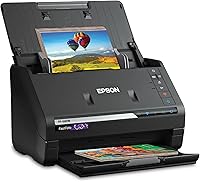
For readers scanning many photos, the Epson FastFoto FF-680W High-Speed Duplex Photo offers batch scanning for up to 36 photos at a time. It handles Polaroid photos, panoramas, postcards, and photos up to 8 x 10 in, with 300 dpi, 600 dpi TIFF, and 1200 dpi options.
The Epson model also scans both sides of a photo in one pass, which can preserve handwritten notes on the back. Its listed features include auto enhancement, color restoration, red-eye reduction, de-skew, crop, and rotate.
Choose it when photo organization and batch work matter more than having a printer built into the same machine. Its 11.7 in D x 11.7 in W x 6.9 in H size and 8.2 lb weight also call for a dedicated place on your desk.
How is a flatbed scanner different from a printer feeder?
A flatbed scanner reads one original from the glass, while an automatic document feeder moves loose pages through the printer. The flatbed is slower for a large stack but more flexible for delicate or unusual originals.
A document feeder is useful for several loose pages of similar size. It can save time when you are scanning forms, letters, or office records.
The flatbed is the safer choice for originals that could crease, tear, jam, or leave the paper path. It also lets you scan pages from a book without removing them from the binding.
Some machines combine both methods. Before buying, check whether the printer has only a flatbed or also includes an automatic document feeder.
What should you look for in a flatbed printer scanner?
Look at glass size, optical resolution, connection type, scan speed, and software support. Your best choice depends on whether you scan photos, documents, or a mix of both.
Glass size
A larger glass area gives you more room for letters, legal pages, photos, and artwork. For oversized originals, compare large-format flatbed scanners.
Measure the originals you scan most often instead of choosing by the printer's outside dimensions alone.
Optical resolution
Optical resolution affects how much detail the scanner captures from the original. Higher resolution can help with detailed photos, but large files take more storage space and may take longer to process.
Connection type
USB works well when the printer or scanner stays near a computer. Wi-Fi can help when you want to place the unit elsewhere or send scans through a wireless network.
Scan controls
Auto Scan Mode can detect whether you placed a document or image on the glass and adjust settings. One-touch buttons can also make common tasks such as copying or creating a PDF quicker.
Software
Software can add searchable PDFs, image corrections, file organization, or cloud sharing. Check which operating systems the model supports before setting up an older computer.
For Windows 11 options, see flatbed scanners for Windows 11.
The Canon Canoscan Lide 300 Scanner has USB connectivity, 2400 x 2400 dpi optical resolution, Auto Scan Mode, and four EZ buttons. It is designed for document and photo scanning and supports media such as photos, receipts, business cards, and paper.
The Canon LiDE 300 suits someone who wants a straightforward scanner for occasional home or office use. Its listed dimensions are 14.5 in D x 9.9 in W x 1.7 in H, and its standard sheet capacity is 1.
If you want a printer that also scans, our guide to Is It Worth Buying a Printer with a Scanner? covers the space-saving trade-off.
Is a flatbed scanner good for old photos?
A flatbed scanner is often a practical choice for old photos because the photo stays on the glass instead of passing through rollers. You can also position each image carefully and choose a resolution that matches your archive or sharing needs.
Dust on the glass or photo can appear in the final file, so clean the surface with a suitable soft cloth before scanning. Keep the lid closed during the scan to block stray light.
The Canon CanoScan LiDE 400 Slim Scanner, 7.7" x 14.5" x 0.4", Document & Photo Scanner, Black offers 4800 x 4800 dpi resolution, color restore, and dust removal features. It uses USB Type-C for data and power and includes a vertical stand.
This Canon model suits readers who want higher listed resolution in a slim scanner. Its stated dimensions are 7.7 in D x 0.4 in W x 14.5 in H, and it supports letter and photo media.
For a closer look at photo-focused models, compare our guide to the best Epson photo scanner. If your main goal is photo quality from a flatbed, see the best flatbed scanner for photos.
Can you scan cards and other thick originals?
You can scan cards and some thick originals if they fit under the flatbed lid and the surface can close safely. Do not force the lid down, and check the scanner's instructions before scanning items with raised surfaces.
Sports cards, postcards, and small artwork benefit from careful placement on the glass. Keep the item flat and centered, and use a resolution that captures the details you need.
Our guide to the best flatbed scanner for sports cards focuses on that use case. A flatbed can also be useful for card backs, where small text and statistics need to remain readable.
What is the difference between a flatbed scanner and a printer scanner combo?
A flatbed scanner is a scanner with a glass bed. A printer scanner combo combines that scanner with printing functions, usually in one all-in-one machine.
A standalone flatbed scanner can make sense if you already own a printer or want a scanner built around photo and document work. A printer scanner combo can save desk space when you also need to print.
The right choice depends on how often you scan and print. If you need both functions regularly, compare our guide to the Best Printer Scanner Combo For Photos.
How do you use a flatbed scanner on a printer?
Place the original face down on the marked corner, close the lid, select the scan or copy function, and save or print the result. Keep the original aligned and avoid opening the lid while the scan head is moving.
For a photo, choose color and select a resolution suited to your goal. For a text document, a document mode or PDF setting may create a cleaner file.
Clean the glass with a soft, appropriate cloth and keep dust away from the lid. Do not place wet originals on the glass, and do not press hard on the lid.
Is a flatbed scanner on a printer worth it?
A flatbed scanner on a printer is worth considering if you copy documents, scan photos, or work with originals that should not pass through rollers. It adds flexibility to an all-in-one printer and can handle originals that a feeder cannot.
Choose the Epson FastFoto FF-680W for large photo batches and double-sided photo notes. Choose the Canon Canoscan Lide 300 for simple USB document and photo scans, or the Canon CanoScan LiDE 400 for a slim design and higher listed resolution.
The best flatbed scanner on a printer is the one that matches your originals, workspace, and scan volume. Measure your largest item, check the connection you need, and choose a printer scanner combo only if printing is part of the same routine.
Frequently asked questions
What is a flatbed scanner on a printer?
A flatbed scanner on a printer is a glass scanning surface inside an all-in-one printer. Place a document or photo face down on the glass, close the lid, and use the printer's controls or software to copy, save, or send the scan.
What can you scan on a flatbed scanner?
You can scan flat originals such as documents, photos, receipts, business cards, and artwork. The glass also suits delicate, thick, unusual, or bound originals that should not pass through a document feeder.
Is a flatbed scanner better than an automatic document feeder?
A flatbed scanner is better for photos, delicate pages, books, receipts, and originals that need careful positioning. An automatic document feeder is faster for stacks of loose pages, so some all-in-one printers include both options.